


Nokia Corporation Sponsored stocks have been trading up by 3.64 percent after upbeat 5G contract wins bolstered investor confidence.
Key Takeaways For NOK Traders
- Q3 numbers from Nokia landed solid, with revenue at EUR 5.15B versus EUR 5.07B expected, 9% net sales growth, and better margins helped by faster Infinera integration.
- The company beat Q3 earnings and guided for a strong Q4, calling for 20%–24% quarter‑over‑quarter net sales growth and backing that up with a regular €0.03 dividend.
- Rosenblatt and JPMorgan trimmed Nokia price targets slightly but kept bullish ratings, framing the roughly 15% post‑earnings share price slide as disconnected from the core fundamentals.
- Nokia is leaning hard into AI‑RAN with Nvidia, T‑Mobile, and SoftBank, lining up pilots and a 2027 commercial trial that cement its push into AI‑driven radio access networks.
- SpaceX’s potential 80,000‑site tower leasing plan and Nokia’s internal use of Cadence’s AuraStack AI Super Agent add longer‑term optionality and efficiency themes to the NOK story.
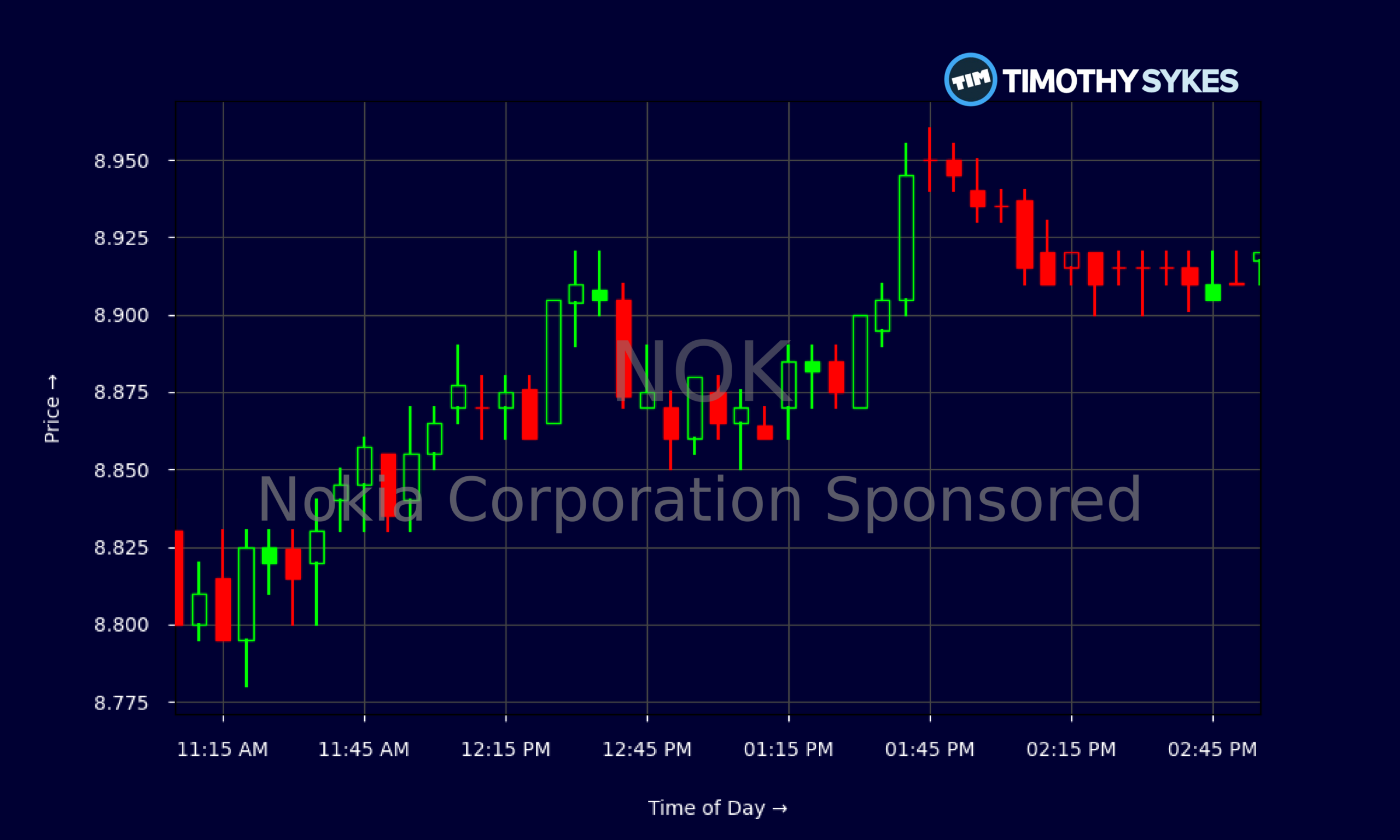
Live Update At 15:03:49 EDT: On Tuesday, October 27, 2026 Nokia Corporation Sponsored stock [NYSE: NOK] is trending up by 3.64%! Discover the key drivers behind this movement as well as our expert analysis in the detailed breakdown below.
Quick Financial Overview
NOK has been on a wild ride this month. The stock slid from around $10.60 on 2026/10/02 down toward the mid‑$7s after earnings volatility, then clawed back to about $8.92 by 2026/10/27. For active traders, that’s a wide, tradeable range with clean swings.
Recently, NOK has been building a short‑term uptrend off the 7.78 low on 2026/10/22. Higher closes on 2026/10/23, 2026/10/26, and 2026/10/27 show dip‑buyers stepping in as the earnings headlines settled. Intraday, the 5‑minute chart is tightly coiled between roughly 8.70 and 8.95, signaling consolidation after the bounce. That kind of tight range often precedes the next directional move.
On the fundamentals side, Nokia generated about $19.22B in revenue, with a price‑to‑sales ratio near 2.58 and a high price‑to‑earnings multiple around 74.4. That P/E tells traders the market is already pricing in growth and margin expansion. Return on equity of 5.82% and a dividend yield near 1.6% suggest NOK is more of a steady compounder than a pure speculation play. For traders, the key is matching this stretched valuation with the fresh earnings and guidance to see if momentum can continue.
Why Traders Are Watching NOK’s AI And Earnings Setup
NOK is back on a lot of screens because the story is cleaner than the chart noise suggests. On the numbers, Nokia beat Q3 expectations on both earnings and revenue and posted year‑over‑year growth. Net sales hit EUR 5.15B against EUR 5.07B estimates, up 9%, and comparable operating margin widened by 220 basis points. Nokia also said integration of Infinera is running ahead of plan, targeting EUR 200M in net synergies by the end of 2026, one year faster than originally guided. That is real operational progress, not just hype.
Guidance is where NOK really flexed. Management is calling for Q4 net sales to jump 20%–24% quarter over quarter and expects operating profit to land above the midpoint of its full‑year comparable operating profit outlook. At the same time, Nokia reaffirmed its 2026 operating profit targets and kept a regular €0.03 quarterly dividend. For many traders, that combination of growth, margin improvement, and steady capital return is a powerful narrative — especially when the stock just took a 15% hit.
On the Street side, Rosenblatt trimmed its Nokia price target from $15 to $14 but stuck with a Buy rating, calling the post‑earnings slide an overreaction linked to a broader AI infrastructure selloff and credit‑spread worries, not Nokia‑specific weakness. JPMorgan made a similar move, nudging its Nokia target from $21 to $20.50 while keeping an Overweight rating and pointing to accelerating opportunities in scale‑out and data center markets. In plain English, big‑name analysts still see NOK as a long‑term winner even as they fine‑tune their models.
The AI angle is what gives NOK extra juice. Nokia is working on AI‑enabled radio access networks (AI‑RAN) with Nvidia and T‑Mobile, using its anyRAN software on Nvidia hardware and tapping Nvidia models in network automation. The company is also preparing a 2027 commercial AI‑RAN trial with SoftBank in Japan, again linking anyRAN with Nvidia’s Aerial RAN Computer. Another data point: Ericsson and Nokia are both cited as RAN suppliers that could benefit if SpaceX pushes ahead with a potential 80,000‑site terrestrial device‑to‑device network. None of these are guaranteed revenue drivers today, but they explain why traders stay glued to NOK when AI‑RAN headlines hit the tape.
Conclusion
For short‑term traders, NOK now sits at an interesting crossroads. The stock’s sharp slide down from the $10s into the high‑$7s, followed by a bounce back near $9, reflects fear washing out just as the fundamental story strengthened. Nokia beat Q3 expectations, expanded margins, guided Q4 revenue up 20%–24% quarter on quarter, and reiterated its 2026 profit outlook while paying a steady dividend. NOK is also tightening its portfolio by moving to sell the Enterprise Campus Edge business to Aurelius, with closing targeted for the first half of 2027, even though terms have not been disclosed.
Layer on the AI angle and you get a multi‑year narrative. Nokia is pushing AI‑RAN with Nvidia, T‑Mobile, and SoftBank, and using Cadence’s AuraStack AI Super Agent internally on the Millennium M2000 AI Supercomputer to automate complex engineering tasks and explore system trade‑offs. Those steps speak to a company serious about both product innovation and internal efficiency, which can matter a lot as telecom and data center spending evolves.
For traders, the game plan is the same as always: let the price action confirm the story. NOK’s current consolidation zone around $8.70–$8.95 will tell you whether this is a base before another leg higher or just a pause before more selling. As millionaire penny stock trader and teacher Tim Sykes, says, “Be patient, don’t force trades, and let the perfect setups come to you.”. As Tim Sykes likes to remind his community, “The market doesn’t care what you believe — it cares what you do when the chart proves you wrong.” Use that mindset with NOK: respect the earnings strength and AI story, but always let the chart and your risk rules lead the way. This coverage is for educational and research purposes only, not investment advice.
This is stock news, not investment advice. Timothy Sykes News delivers real-time stock market news focused on key catalysts driving short-term price movements. Our content is tailored for active traders and investors seeking to capitalize on rapid price fluctuations, particularly in volatile sectors like penny stocks. Readers come to us for detailed coverage on earnings reports, mergers, FDA approvals, new contracts, and unusual trading volumes that can trigger significant short-term price action. Some users utilize our news to explain sudden stock movements, while others rely on it for diligent research into potential investment opportunities.
Dive deeper into the world of trading with Timothy Sykes, renowned for his expertise in penny stocks. Explore his top picks and discover the strategies that have propelled him to success with these articles:
- Penny Stocks Trading Guide
- Best Penny Stocks Under $1 to Buy Today
- Top 8 Penny Stocks to Watch on Robinhood
Once you’ve got some stocks on watch, elevate your trading game with StocksToTrade the ultimate platform for traders. With specialized tools for swing and day trading, StocksToTrade will guide you through the market’s twists and turns.
Dig into StocksToTrade’s watchlists here:
- AI Penny Stocks
- Robinhood Penny Stocks
- Top Biotech Stocks
How much has this post helped you?
(0 votes, average: 0 out of 5)
* Results are not typical and will vary from person to person. Making money trading stocks takes time, dedication, and hard work. There are inherent risks involved with investing in the stock market, including the loss of your investment. Past performance in the market is not indicative of future results. Any investment is at your own risk. See Terms of Service here
The available research on day trading suggests that most active traders lose money. Fees and overtrading are major contributors to these losses.
A 2000 study called “Trading is Hazardous to Your Wealth: The Common Stock Investment Performance of Individual Investors” evaluated 66,465 U.S. households that held stocks from 1991 to 1996. The households that traded most averaged an 11.4% annual return during a period where the overall market gained 17.9%. These lower returns were attributed to overconfidence.
A 2014 paper (revised 2019) titled “Learning Fast or Slow?” analyzed the complete transaction history of the Taiwan Stock Exchange between 1992 and 2006. It looked at the ongoing performance of day traders in this sample, and found that 97% of day traders can expect to lose money from trading, and more than 90% of all day trading volume can be traced to investors who predictably lose money. Additionally, it tied the behavior of gamblers and drivers who get more speeding tickets to overtrading, and cited studies showing that legalized gambling has an inverse effect on trading volume.
A 2019 research study (revised 2020) called “Day Trading for a Living?” observed 19,646 Brazilian futures contract traders who started day trading from 2013 to 2015, and recorded two years of their trading activity. The study authors found that 97% of traders with more than 300 days actively trading lost money, and only 1.1% earned more than the Brazilian minimum wage ($16 USD per day). They hypothesized that the greater returns shown in previous studies did not differentiate between frequent day traders and those who traded rarely, and that more frequent trading activity decreases the chance of profitability.
These studies show the wide variance of the available data on day trading profitability. One thing that seems clear from the research is that most day traders lose money .
Millionaire Media 66 W Flagler St. Ste. 900 Miami, FL 33130 United States (888) 878-3621 This is for information purposes only as Millionaire Media LLC nor Timothy Sykes is registered as a securities broker-dealer or an investment adviser. No information herein is intended as securities brokerage, investment, tax, accounting or legal advice, as an offer or solicitation of an offer to sell or buy, or as an endorsement, recommendation or sponsorship of any company, security or fund. Millionaire Media LLC and Timothy Sykes cannot and does not assess, verify or guarantee the adequacy, accuracy or completeness of any information, the suitability or profitability of any particular investment, or the potential value of any investment or informational source. The reader bears responsibility for his/her own investment research and decisions, should seek the advice of a qualified securities professional before making any investment, and investigate and fully understand any and all risks before investing. Millionaire Media LLC and Timothy Sykes in no way warrants the solvency, financial condition, or investment advisability of any of the securities mentioned in communications or websites. In addition, Millionaire Media LLC and Timothy Sykes accepts no liability whatsoever for any direct or consequential loss arising from any use of this information. This information is not intended to be used as the sole basis of any investment decision, nor should it be construed as advice designed to meet the investment needs of any particular investor. Past performance is not necessarily indicative of future returns.
Citations for Disclaimer
Barber, Brad M. and Odean, Terrance, Trading is Hazardous to Your Wealth: The Common Stock Investment Performance of Individual Investors. Available at SSRN: “Day Trading for a Living?”
Barber, Brad M. and Lee, Yi-Tsung and Liu, Yu-Jane and Odean, Terrance and Zhang, Ke, Learning Fast or Slow? (May 28, 2019). Forthcoming: Review of Asset Pricing Studies, Available at SSRN: “https://ssrn.com/abstract=2535636”
Chague, Fernando and De-Losso, Rodrigo and Giovannetti, Bruno, Day Trading for a Living? (June 11, 2020). Available at SSRN: “https://ssrn.com/abstract=3423101”
