

Google updated its privacy policy to allow content from Gmail, Google Photos, and Google Drive to play a role in personalized ads when users connect those apps to other Google services, according to gHacks.
The revised policy took effect on October 16 and mainly applies to searchers who opt into Personal Intelligence in Gemini and AI Mode in Search.
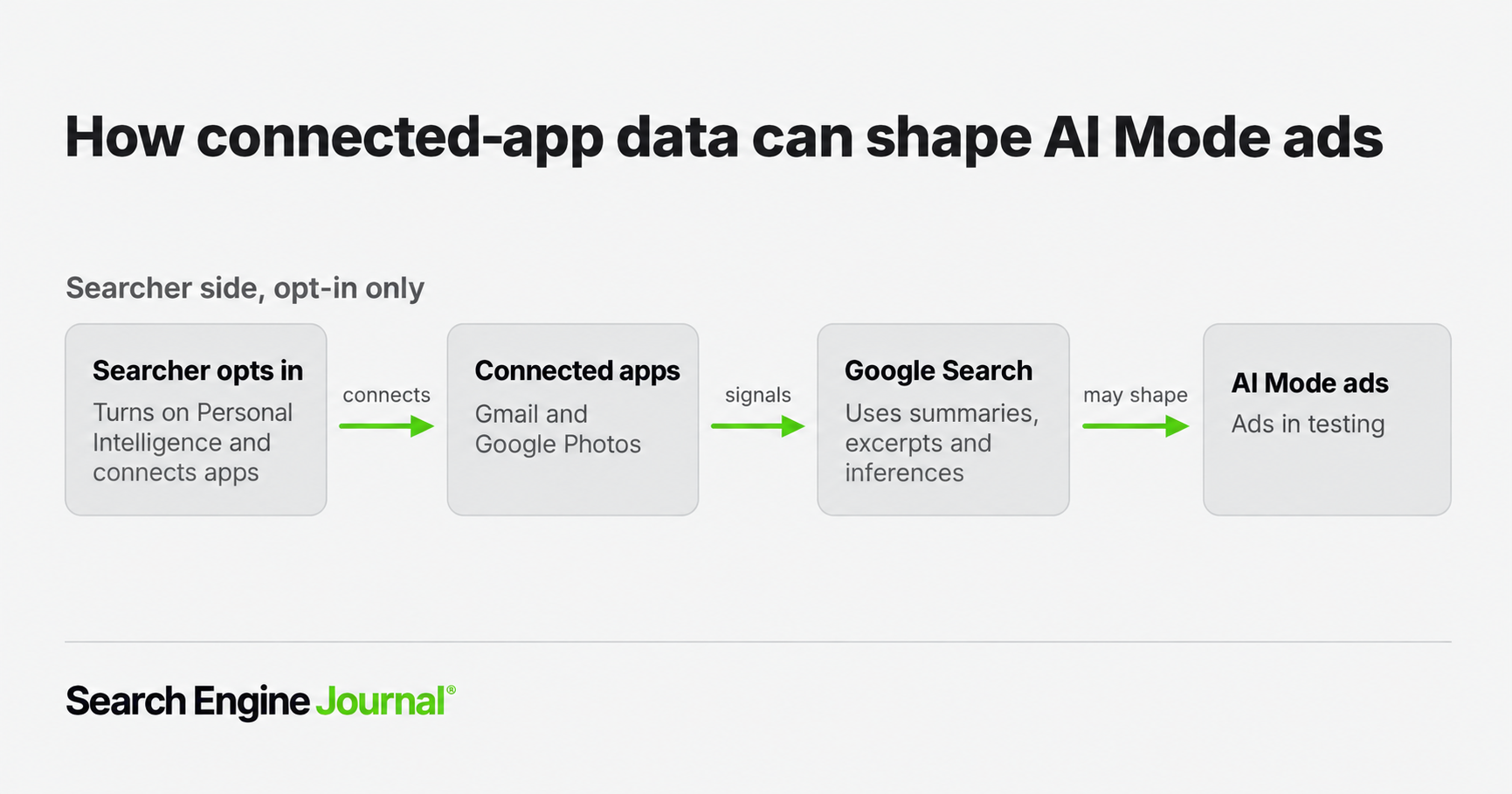
Alongside the policy update, Google has started testing AI Mode ads for users who have Personal Intelligence turned on.
Here’s what’s changing, how connected-app signals work in AI Mode, and what you can actually check inside your Google Ads accounts.
What Changed In Google’s Privacy Policy
For years, Google’s privacy policy has stated that they don’t show personalized ads based on content from Drive, Gmail, or Photos. Google scanned free Gmail accounts to target ads until 2017 before ending the practice.
The updated policy keeps that statement but adds an exception:
…unless you choose to make data from these services available to other Google services that support personalized ads.
A new passage explains that users can give Search or Gemini Apps access to information from other Google apps. How that information can be used depends on the settings and policies of the service accessing it.
Google specifically says Search may use some of that information to personalize content, including ads. For users who connect apps to Search, information shared for personalized assistance may also influence the ads they see.
How Personal Intelligence Shapes Ads In AI Mode
Personal Intelligence is an opt-in feature that lets Gemini and AI Mode in Search pull context from connected apps. Google first launched the feature in January 2026 as a Labs experiment in English in the U.S. for Google AI Pro and AI Ultra subscribers using personal Google accounts, excluding Workspace business, enterprise, and education accounts.
Google introduced it in Search in January 2026 as a Labs experiment for eligible U.S. Google AI Pro and Ultra subscribers. Users could connect Gmail and Google Photos through their personal Google accounts.
When a searcher uses Personal Intelligence, AI Mode can reference a hotel booking or flight confirmation in Gmail alongside travel pictures in Google Photos to tailor its responses.
Robby Stein, VP of Product for Google Search, described how this works for retail queries in Google’s January announcement:
Personal Intelligence can also be particularly helpful for shopping, because AI Mode considers the types of items you buy and where you shop. If you need a new coat for your upcoming trip, AI Mode could automatically take into account the brands you prefer, as well as your flight confirmation in Gmail to identify the destination and timing (Chicago in March). You’ll get suggestions for windproof, versatile coats that fit the weather and your preferred look. It’s like a personal shopper who already knows your itinerary and the vibe you’re going for.
When Google expanded the feature in March, the company said the Personal Intelligence experience would stay ad-free for now, while noting it expected ads to work in a similar way for connected users later. Now, Google is testing ads within that connected experience.
According to Google’s Search Help documentation cited by The Keyword, ads aren’t matched directly to the raw contents of an email or photo library. Instead, the help page states that Search may reference summaries, excerpts, and inferences from connected sources to personalize the experience, and that the same information may be used to show ads.
Google also outlines several boundaries around how this data is handled:
- No advertiser access: Advertisers won’t get access to a user’s connected Gmail inbox or Google Photos library.
- Sensitive categories stay excluded: Google doesn’t show personalized ads based on sensitive categories, which it lists as race, religion, sexual orientation, and health.
- User opt-out controls: Searchers can keep Gmail and Photos out of ad personalization by turning off personalized ads in My Ad Center, or by opening Search personalization settings in their Google Account, selecting Connected Content Apps, and disconnecting the apps.
Turning off ad personalization in My Ad Center doesn’t necessarily stop connected apps from feeding data into AI features, so disconnecting the apps is the only way for a user to remove Gmail and Photos from Personal Intelligence entirely.
Additionally, Google’s help page notes that connected-app summaries, excerpts, and inferences may be used to train Google’s generative AI models, and a subset of data processed by AI Mode and Ask Maps is reviewed by human reviewers.
Why This Matters For Advertisers
If you’re looking for a new targeting toggle or audience segment inside Google Ads, you won’t find one.
Personal Intelligence sits entirely on the searcher’s side. Google hasn’t announced any new advertiser controls, targeting options, or dedicated reporting for the Personal Intelligence ad test. That means connected-app inferences can influence which ads an opted-in user sees in AI Mode, but you can’t directly target, segment, or bid on Gmail or Photos insights.
Instead, campaign eligibility follows the existing rules for ads in AI Mode. Google named three campaign types as eligible for AI Mode ad testing: Performance Max, Shopping, and Search campaigns using broad match, including AI Max for Search.
That eligibility doesn’t confirm that a campaign has served ads to Personal Intelligence users. Google also hasn’t announced separate eligibility requirements for this test.
For eligible advertisers, connected apps could supply information about a shopping need that someone hasn’t included in their query. However, advertisers have limited visibility into whether that information contributes to delivery or results.
The available reporting has two limitations:
- No dedicated Personal Intelligence reporting: Google hasn’t announced a report showing when connected-app information influenced an impression.
- AI Max reports don’t (and likely won’t) identify these signals: Search term, asset and landing page reports show AI Max performance, without identifying whether Gmail or Photos information contributed.
What’s Still Unknown
Google has not said when ads in AI Mode for users with Personal Intelligence enabled will move beyond testing, or whether advertisers will eventually get dedicated reporting or placement controls for AI Mode.
It also remains unclear whether connected-app signals personalize ads only inside AI Mode or across other Google properties. While the test is described for AI Mode, The Keyword observed that Google’s help page answers the ad personalization question for “Search Services” as a whole, a group the page defines as Google Search (including AI Mode and Discover), Maps, Shopping, Flights, Hotels, Translate, and News.
Google is also replacing its Web & App Activity and Search Personalization controls with two new settings, Search Services History and Personalized Recommendations, over the coming months. We’ll continue watching the rollout and update this article as Google shares additional details on ad eligibility and reporting.
Featured image: Primakov / Shutterstock
