

Samsung’s Exynos 2600 SoC is now official. After confirming its existence recently, Samsung has fully unveiled its latest flagship mobile chipset.
Built on Samsung Foundry’s 2nm GAA process, the Exynos 2600 is the world’s first 2nm smartphone chip. It packs a 10-core CPU based on the Arm v9.3 architecture and debuts Heat Path Block (HPB) technology to enhance heat management.
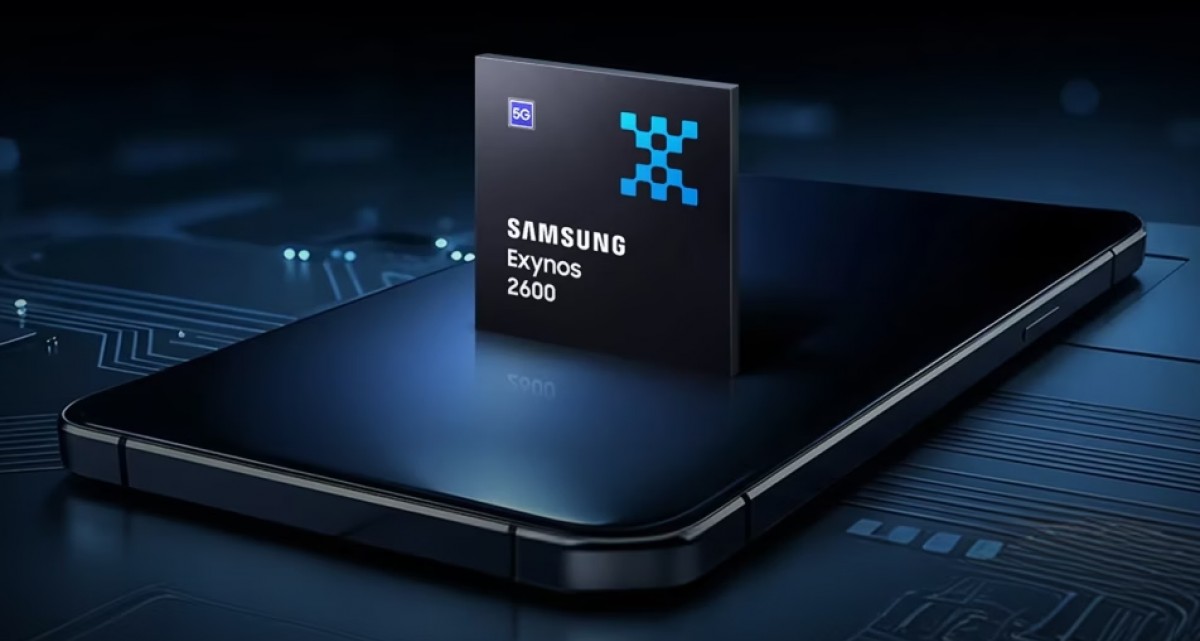
The Exynos 2600 features a 10-core CPU configuration comprising one prime core, three high-performance cores, and six high-efficiency cores. A prime C1-Ultra core is clocked at 3.8GHz, three C1 Pro cores run at 3.25GHz, and an additional six C1 Pro cores are operating at a lower 2.75GHz.
According to Samsung, the new chipset delivers up to a 39% performance improvement over the Exynos 2500, while also offering better power efficiency.

On the AI front, the Exynos 2600 introduces a new NPU that is claimed to provide a 113% improvement in AI performance compared to its predecessor. The chipset also enhances security with features such as virtualization security and hardware-backed hybrid post-quantum cryptography.
For gaming, the Exynos 2600 is equipped with the Xclipse 960 GPU, which Samsung says delivers up to 50% higher ray-tracing performance and double the compute performance versus the Exynos 2500.

In imaging, the chipset’s ISP gains a new AI-based Visual Perception System (VPS), enabling more accurate recognition of scenes and objects. It supports camera sensors of up to 320MP and introduces deep learning-based video noise reduction for improved low-light video capture.
The Exynos 2600 also debuts Samsung’s new Heat Path Block (HPB) technology, which uses High-k EMC material to improve heat dissipation and deliver sustained high performance under stress or gaming.

Other key specifications include support for LPDDR5X memory, UFS 4.1 storage, and 4K displays with refresh rates of up to 120Hz.
Samsung is expected to use the Exynos 2600 in the upcoming Galaxy S26 and Galaxy S26+ flagships, although reports remain inconsistent. While one rumor suggests the chipset will be used across multiple global markets, a newer claim says it may be limited to Korea. An official announcement will be needed to confirm Samsung’s final plans.
Source
