I tested the SecondBrain VoicePad for weeks, and its whisper dictation won me over
AI gadgets are all the rage this year. From small recorders you carry everywhere, like the Plaud NotePin, to note-taking and meeting organizers like the Mobvoi TicNote, you can easily find something that works for your setup and AI agent of choice.
But since I have Gemini on my Pixel 11 Pro XL, I don't really feel the need to carry another gadget with me. At my desk, though, it's another matter. Despite installing Gemini and Claude on my iMac, my computer still feels a little behind the times.
When Genspark reached out to ask if I wanted to check out the upcoming SecondBrain VoicePad, I was excited to give it a go. A tiny gadget with an excellent microphone and a few buttons seems like what I need to get things done on my computer. I've been testing it out for a few weeks, and I'm starting to become a convert.
Small, simple, but excellent hardware
All you need are five buttons and a good microphone
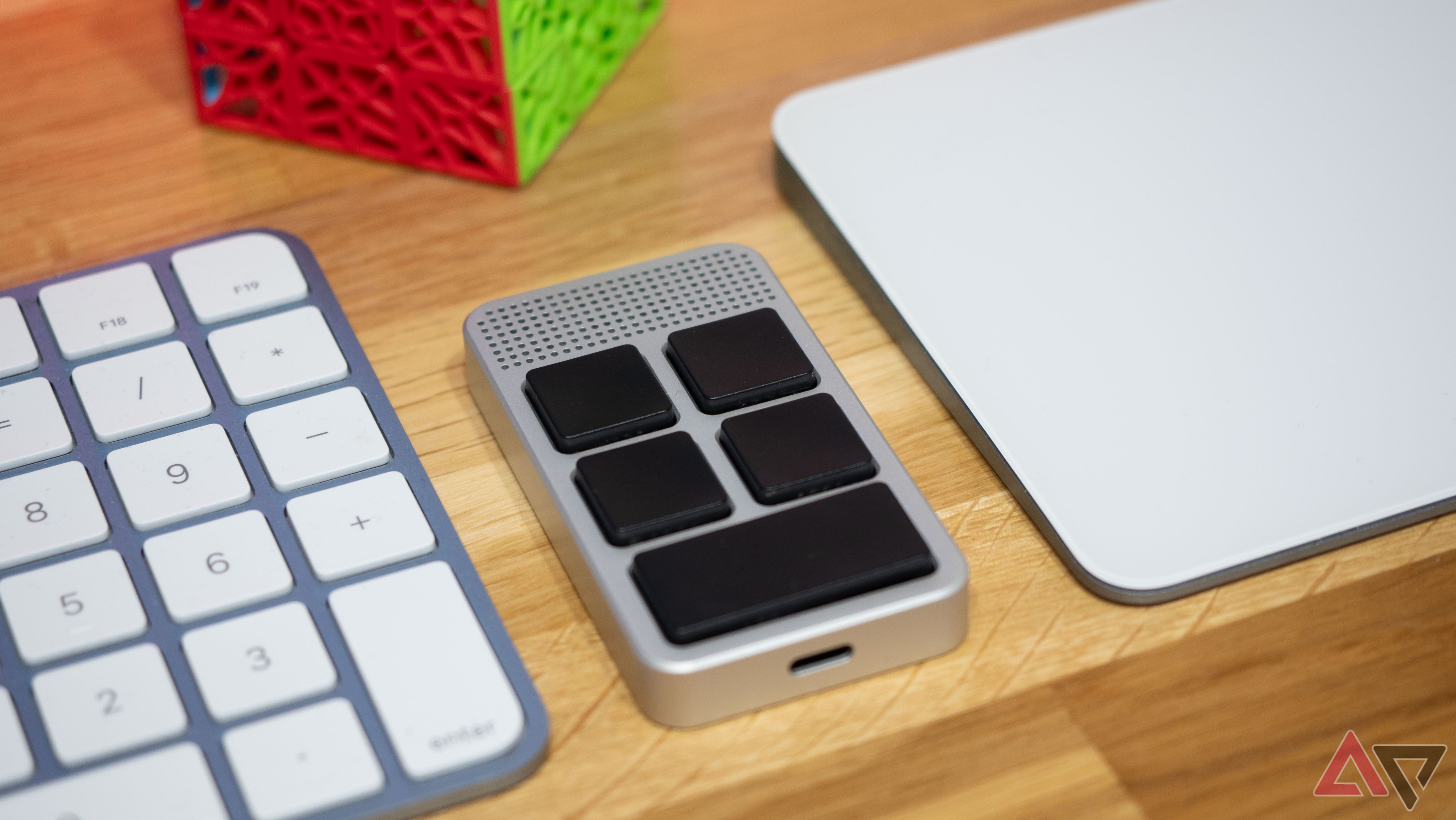
The SecondBrain VoicePad, designed by Genspark is a small, portable gadget that's almost a quarter the size of my Pixel 11 Pro XL. It's relatively thick, but that thickness gives it heft and quality. There's a speaker and microphone grille at the top, five large black buttons, a power toggle on the side, and a USB-C port at the bottom.
The buttons are very clicky. There are Cherry MX Ultra Low Profile Tactile switches below each one, providing the exact level of resistance and give, and making the sensation of clicking and releasing very satisfying.
That's all there is to it, but you don't need more. It's the software that matters, and for that, you need the Genspark Super App installed on your Windows, Mac, or Linux computer. Support for the SecondBrain VoicePad is still in beta now, since the product is still being crowdfunded.
Push-to-talk is like having Gboard's Rambler at my desktop
The Genspark app improves any text I type
Every button on the SecondBrain VoicePad can be customized to perform one specific action, or an entire script of actions. By default, the large bottom button is assigned to a push-to-talk function. I kept that. I just hold it down, bring the device to my mouth, and start talking.
The Genspark app transcribes everything I say and inserts it into any text field, no matter where the cursor is. This works in Google Chrome, Safari, Slack, Microsoft Teams, the Notes app, Gemini, or any other app on my Mac really.
It isn't a basic voice-to-text transformation, though. Genspark removes all my "ums" and "ahs" and cleans up my text from random words such as "like." If I make mistakes and go back to correct them while talking, it will fix those, too.
If you have used Google's Rambler functionality on Gboard, it's basically the same: It works by analyzing your text and keeping the essential and correct parts, while removing all the fluff and errors and blabbering you do along the way.
Say, for example, that I'm making a shopping list and telling it to add tomatoes, onions, corn, garlic, and then I remember that I do have garlic. I can go back and say: "No, don't add garlic." And it will remove it from the transcribed text.
Another feature of the app is when I select already-typed or transcribed text, I can tell it to make that text professional, add emojis, make it more friendly, or change a specific word or phrase, and it will do that.
For that reason, I've assigned one of the buttons to emulate a "Command + A" click on my keyboard. So I push to talk, release, read the text, and if something doesn't look good, I click the CMD+A button to select all text, then push to talk again to ask it to fix what needs fixing.
This workflow has become indispensable for me, since it allows me to dictate a lot of text without stopping to make manual edits along the way.
Whispering is better than talking
It works in noisy environments, too
You might be thinking you can do all of this with the Gemini, Claude, or ChatGPT app on your computer. Gemini, for example, allows you to dictate text in any field, and it will do a similar cleanup on your transcribed text. You're right.
However, the difference is that with the SecondBrain VoicePad, I am able to whisper to the gadget without raising my voice, which means that I can dictate text in public, such as in coffee shops, airports, train stations, and busy offices, without disrupting the people around me and without them overhearing what I'm saying.
And by whisper I don't just mean speak in a low voice; I mean really, really, really whisper. Not raising my voice a single decibel more than necessary. The microphones are so good that they're able to pick this up no matter what's happening around me, and without being sidetracked by other sounds and chats happening around me in a busy café, for example.
Meetings, Live translations, and notes
Other features are available in the Genspark Super App
Now, you might be wondering what else you can do with these buttons. The app lets you map them to almost any function on your computer, from muting the mic (something I assigned, so I can quickly talk go back to mute during Meet and Teams calls) to Enter, Page Up, opening settings, launching a specific app, and more.
One of Genspark's special features is the ability to record meetings with a double-press, even when I'm not near my computer or connected to it. I've been using this around the house, double-pressing to dictate ideas and thoughts, with another double-press to stop it. When I'm back at my desk, I find the recordings in the app, download them, and see the transcribed text. Genspark lets me save these as PDFs, store them in Notion, or even switch the transcription template to a 1:1 meeting, lecture, general notes, and so on.
Another feature is straightforward note functionality, but this one requires being connected to my computer. Press it, speak, and watch your words get transformed into a clean note with proper formatting, headings, and bullet points.
I did this when I was collecting my ideas about the SecondBrain VoicePad, as you can see in the second and third screenshots above, and it transformed my ramblings into a clear and itemized note that I can download or share.
I'm confused, however, by the existence of two relatively similar features: Meeting Notes and Recordings, especially since the VoicePad's "Meeting Notes" button results in voice Recordings in the app that have to be transcribed, and the "Start/Stop recording" button results in automatically transcribed text in the app's Meeting Notes section. Perhaps the mix-up is a bug that needs to be ironed out.
There's also a Live translation option. Assign a button to it, push it, start talking in any language(s), and the text will be immediately translated into your chosen output language. And yes, it keeps up if you can jump between languages mid-sentence.
I speak French, English, Arabic, and some Spanish, so I tested it with all of these and found it relatively good at picking up the right language and the words I was saying — well, aside from a few instances where it thought I was speaking Mandarin.
Translation works with both the computer's external mics (i.e. the connected VoicePad) but also any internal sounds, too. It can thus live caption videos, even if you're wearing headphones and no sound is physically coming out of the speaker.
My only issue with this feature is that I can't download or share the entire translated text; I have to manually copy line by line.
So what are the flaws?
Missing features and expensive hardware
The SecondBrain VoicePad is still in beta and currently being crowdfunded starting at $119 (the retail price should be around $169). Obviously, though, there's a subscription model behind it that's a bit confusing to understand.Voice typing in any app and translation are free and unlimited for the first year. After that, you're down to 4,000 words of free dictation per week, and live translation costs 1 Genspark credit per minute. You also get 300 minutes of meeting note transcriptions and AI summaries per month. After that, it's 5 credits per minute.It's confusing, and you won't know exactly how much you need until you start using the device. Luckily, though, you can assign the keys to any other AI agent — I have one of them set to use Gemini's text input, so I don't even have to rely on the Genspark app except to map the key.You can dictate to Claude, ChatGPT, or any other AI app you use and bypass Genspark — that's the beauty of this tiny keyboard's customization. Just keep in mind that you might need to assign a key to Enter to send the text, or create a script that listens for dictation and then emulates an Enter press.My biggest technical annoyance with the SecondBrain VoicePad, though, is that I can't assign multiple actions to the same key. For example, I can choose whether to trigger Mute with a short or long press of a button, but if I pick the long press, I can't assign the short one to something else. It's infuriatingly limited.I'm also miffed that the functions can't vary depending on the app in the foreground. I'd love it if I could trigger different actions with each key when I'm using Lightroom and others when I'm in Photoshop, Chrome, Gemini, or Claude, for example.I'm also still wondering what the big speaker is used for. I've heard it say it's connected and... that's it. Nothing else. I hope Genspark has plans to make the most out of this big speaker.
A smarter keyboard for the AI generation
Almost everything the SecondBrain VoicePad does can be done with your computer's mic and by assigning shortcuts to different functions. However, you need to speak loudly at your computer or lean over for it to pick up what you're saying, especially if you're in a public place or a noisy environment.
The ability to whisper, especially to a device that I can put right up to my mouth, has made me embrace voice dictation more. I used to be reluctant to speak to my Mac because I tend to make a lot of mistakes, and my initial text version is not as clean as I would like it to be.
The buttons are also extremely useful to trigger functions, launch Gemini or Claude, and start talking, without thinking about complicated keyboard shortcuts. However, I wish the app would let me map a click, double-click, and hold function to every button, making the total 15 different shortcuts instead of five.
I'm also not completely sold on the subscription requirement and plan for the device. Genspark is offering a lot of features for free for the first year, and some over the lifetime of the device. But most users won't understand how much they need to pay until they start using it.
Whether you think you need something like this in your life is very subjective. I've found that it helps me write text faster and more efficiently, and I'm slowly embracing its note-taking ability, but it definitely took several weeks for me to see those benefits.
Source: Read original article

Comments ()