iPad mini eighth generation review: Still the best e-reader, not an iPad Pro mini

The OLED screen in the eighth generation iPad mini is a good reason to get the new model, but on the high end, for iPad Pro prices, it doesn't hit iPad Pro heights.
The iPad mini didn't start premium. At launch, it was a less expensive iPad, with a smaller form factor than the main line.
It's evolved into the pocket-sized powerhouse model, and it's had a pretty good existence so far. It is the best and most flexible e-reader anybody has ever made, for instance.
It's been two years since the last iPad mini update. And, in the midst of RAMpocalypse in 2026, the iPad 8 got a considerable upgrade beyond just that new OLED screen.
As always, the situation more complex than it looks on the surface.
iPad mini 8 review: A thinner, sealed design
At a glance externally, the iPad mini 8 is not redesigned, and retains the same design language as the last. It is a tiny bit thinner and lighter, though, so most of your old cases won't work.

iPad mini 8 review: The updated iPad mini 8 is significantly thinner, lighter, and a bit smaller than the outgoing model
It's still 7.69 inches long, but the width has been shaved from 5.3 inches to 5.22 inches.
More meaningfully different is the thickness, which has gone from 0.25 inches to 0.21 inches, or 0.63mm to 0.54mm. That's a 16% difference in thickness, which is massive even at this small scale.

iPad mini 8 review: The new speaker system is surprisingly effective
The speakers are different in the iPad mini this go-around. As such the unit gets an IP67 water rating. This does bring it in line with the iPhone lineup for water resistance, though you still wouldn't want to submerge or swim with it. More on that in a bit.
The color choice is also a little more basic in 2026. Gone are the colorful blue and purple, with your options now down to Starlight or Midnight.
It's not the end of the world, especially if you're the kind of person who invests in a case at the same time. And you're going to need a new one, since most don't fit.
If you haven't used the top-mounted iPad mini Touch ID before, that takes a bit of getting used to.
As it has always been, the build is solid.
iPad mini 8 review: The change to OLED
The OLED display is the main reason to care about the refresh. It is the non-Pro iPad's biggest upgrade in years, let alone the mini's.
The 8.5-inch Super Retina XDR panel replaces the backlit LCD. It's a hair larger than the previous model, thanks to the slimmer bezels.

iPad mini 8 review: The new OLED display with nanotexture
There's also a few more pixels to play with, at 2,316 by 1,512. It's still got the density of previous generations at 326 pixels per inch.
The hybrid OLED with LTPS panel gives it true blacks and per-pixel illumination control, which significantly helps the image quality. Colors are more vibrant, with the contrast ratio of 2 million to one helping it along the way.
It's also much brighter too, with it managing 600 nits for standard content. HDR pushes it further, with a peak of 1,200 nits.
This is a Pro-level display, with a big exception. The panel still runs at 60Hz, so you're not getting ProMotion here.
I don't think that Apple scored 60Hz OLED displays from the back of a truck somehow. As with much in 2026, this is about silicon.
It looks to me, based on some poking I've done, that the limit is in the controller chip. And based on that poking, it's about silicon availability and costs.
There is a giant price difference between a 60Hz controller and a 120Hz plus controller. Apple is fine with paying that on the iPad Pro, and on the Mac.

iPad mini 8 review: The new A20 Pro model (left) has slimmer bezels and more screen real estate than the old model (right)
It's apparently less fine on the iPad mini. I do expect it in an iteration or two down the road, but who knows how long that is going to take.
And yes, it does not matter as a media consumption tool. It absolutely does for gaming.
As such, there's a lot of screaming about this online. How much this matters very much depends on your own use case.
I'm glad my iPad Pro is ProMotion. I don't care that my iPad mini is not. Your mileage may vary, but to say that it doesn't matter that the iPad mini is 60Hz across the board is not a good take.
In daily use, you can tell if you put a ProMotion display next to this one. If that's aggravating depends user to user.

iPad mini 8 review: The nanotexture screen, combined with the brighter OLED display, make reading outside with the new iPad mini better than ever
You do still get the option to add a $100 Nano-texture glass treatment, so you can remove glare just like the premium models. You can't get this on the 128GB storage model to keep the number of SKUs down.
The display is a big change for the model and serves as an example of what to expect from Apple in the near future when it brings OLED to more products.
OLED on iPad mini for the first time, and Pulse Width Modulation
There is a lot to Pulse Width Modulation in electronics as a whole. As it pertains to the OLED display in iPad mini, Pulse Width Modulation is what Apple uses to regulate the brightness of individual color cells in the eye displays.
An incandescent bulb that can dim throws off fewer photons when at a lower wattage, roughly proportional to the magnitude of the cut in power. Provide half the power to an incandescent bulb, and it will be about half as bright. It does not turn off quickly and strobe — it just emits fewer photons because of the lower power.
In any OLED display, brightness control and color mixing is accomplished by turning individual color cells on and off very quickly. If full power, constantly, is being applied to a color cell, then that cell is "on time" or at a 100% duty cycle, and is fully bright.
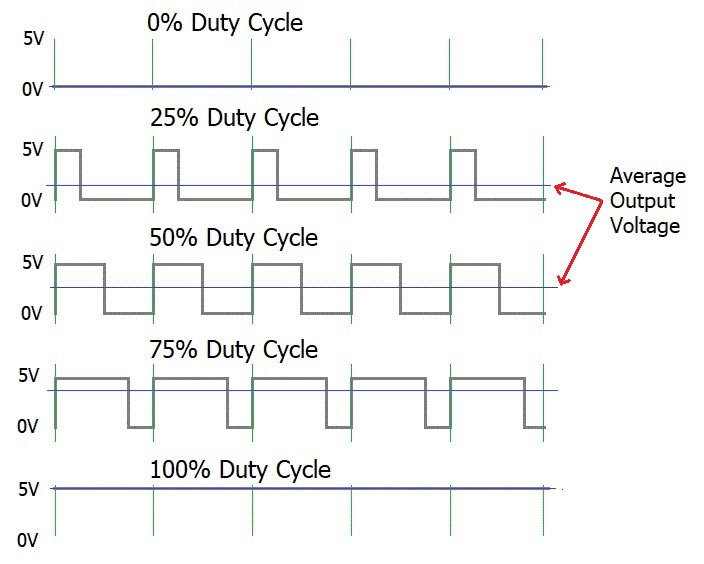
Pulse width modulation and duty cycle example - credit circuitdigest.com
While there is an overall screen refresh frequency factor to consider as it pertains to health, in short, given a fixed frequency, to reduce the brightness, the color cell is extremely rapidly turned on and off.
This is complex, so we're going to simplify it a bit. A 50% duty cycle has the cell on or off half of the time, and is about half the brightness. It also effectively strobes the user at a different frequency than the display as a whole is doing.
Pulse Width Modulation has been used in OLED iPhones since the iPhone X, and it is important but not vital anymore to the operation of the screen. It has always been a health concern at some level, to some people.
If you haven't had sensitivity with your iPhone or iPad before, you're still good to go. But given that this is the first OLED iPad mini, it's worth talking about again.
Our advice is the same as it has always been. If you start feeling strange in any way while using iPad mini, or for that matter, anything with a screen, stop using it. Talk to your doctor about it.
And, there's Display Pulse Smoothing in accessibility on not just the iPhone, but this iPad mini too. It does impact low brightness performance, given that it is a reduction in voltage to cells, but that's a small price to pay if you're impacted by the strobing.
iPad mini 8 review: Camera and audio
While the display is the big change, the cameras are not. Changing the screen is certainly part of an enhanced spec-bump update, but not everything gets to change.

iPad mini 8 review: The new camera bump is smaller than before
The cameras carry over in spirit from the old model. The rear is a 12MP wide shooter at f/1.8, which is slightly disappointing.
It still records 4K video at up to 60fps, has a 5x digital zoom, and can use Smart HDR 4 for photographs.
The front is a little bit different. Sure, it's a 12MP Ultra Wide like before, but it's on the long edge for use in a landscape orientation. This is a change other iPad models have already undertaken, so it's nice to see here.

iPad mini 8 review: The front facing camera still lacks Face ID, but it has relocated to the landscape edge
The aperture is a little wider at f/2.0, and Center Stage is also in play for reframing your FaceTime calls.
For audio, there's a considerable difference. The landscape stereo speakers of the past are gone, in favor of a new Acoustic Display.
As the name implies the audio plays through the display, vibrating it. There's still has stereo audio support, which is nice.
That Acoustic Display is interesting. In short, the new speakers on the iPad mini shake the screen to help project the sound.
The sound is in fact richer than it is on the last few iPad mini models. It is not iPad Pro-level, nor even MacBook Pro level.
Apple is great at small-form speakers, but the physics of air movement are remorseless. I'm expecting this to come to the iPhone sooner rather than later, but the physics of the smaller screen may be limiting. We'll see.
There's no change to the microphones, though. There's still a pair of them used to capture your voice for calls.
They are fit for task, but you probably won't be recording your true crime podcast on them.
iPad mini 8 review: The A20 Pro and connectivity
Inside is Apple's A20 Pro chip. It is a three-generation jump over the old A17 Pro. That said, there's still a little variation depending on the model you get.
The 128GB and 256GB models use a 5-core CPU, with two super cores and three efficiency cores, as well as a 16-core Neural Engine.

iPad mini 8 review: The A20 Pro is powerful enough for excellent mobile gaming
If you splash out for the 512GB model, you get an extra efficiency core for the CPU, bringing the total to six cores. The Neural Engine is also upgraded to a Dual 16-core version, which will help with AI-centric tasks.
Both variants do benefit from a seven-core GPU with hardware-accelerated ray-tracing. More importantly, the per-GPU-core Neural Accelerators will further aid the Neural Engine with its tasks.
Apple is very much pushing AI as a big feature of its ecosystem. After the iPhones, it makes sense for the iPads to get the same treatment.

When it comes to benchmarks, the six-core variant achieves 3,945 in Geekbench 7 for the single-core test. The five-core version fares similarly, since the test deals with the single fastest available core, and that doesn't change.
Both are far ahead of the iPad mini 7, which achieves 2,526. The disparity is a sure sign of a multi-generational chip difference.

Moving to multi-core, the new iPad mini does differ, depending on the core counts. The higher-core version gets 11,192, with the lower hitting 9,837.
These are still miles better than the iPad mini 7's A17 Pro at 6,741.

On to Metal, and there's yet another massive difference in generations. The 20,526 of the iPad mini 7 is admirable, but the seven-core GPU in both A20 Pro variants destroys it at over 58,000.
Connectivity sees gains too. Wi-Fi moves to Wi-Fi 7, and Bluetooth to version 6. With the multi-year upgrade cycle for the iPad mini, this is a bit of future-proofing on Apple's side.
The USB-C port, primarily used for charging, stays at USB 3 and 10Gbps for data transfers. There is no Thunderbolt upgrade yet, but that is another thing you'd expect from a Pro model.
If you opt for a cellular model, you do get 5G connectivity once again. There is still no move on mmWave support though, so you're going to get sub-6GHz and that's it.
That is, unless you tether to an iPhone.
Battery life holds at the usual ten hours for video streaming, which isn't new for Apple. Ten hours is its general benchmark for the iPad mini battery.
What is interesting is that Apple does this with a slightly smaller cell.
The battery shrinks to 18.9 watt-hours, versus 19.3 watt-hours in the previous one. It's probably a combination of processing efficiency and the benefits of OLED at play, but it's a shame that it's not used for battery life to go up.
I'd have preferred that the iPad mini have stayed the same size as the previous model and eked out that 19.3 watt-hours.
iPad mini 8 review: More than a spec bump
The iPad mini 8 is a spec-bump update with one genuine exception in the form of the OLED display. It's one doozy of an exception.

iPad mini 8 review: The top has a power button with Face ID and the volume rockers
It's a change that gives the iPad mini a much more premium feeling. Before, it was a purposefully small tablet, but now it's one that you'd be more willing to show off.
There'll be no more feelings of inadequacy when it's placed next to an iPhone display. It's just as contrast-heavy and vibrant as your daily driver smartphone.
Pairing that with the A20 makes it a powerhouse without crossing the line into the realm of Pro.
What Apple has come up with is a pocket iPad Pro that's doesn't have as much multi-core grunt as the M-series chips, but still quite capable given that nearly every iPad mini use case is a single-core processing job.
The lack of LiDAR or ProMotion sets it apart from the Pro iPad line but the camera does the job in a pinch. Regardless, your iPhone camera, assuming it's newer than an iPhone 14 Pro, will be better than the cameras in even the iPad Pro.
At that launch I talked about earlier, the iPad mini was an option for users who wanted an iPad but without the size. Now, it's an option for someone who wants better than the baseline iPad, but also wants to avoid the sizing of the iPad Air.
The only real problem is the start price of $699 for 128GB of capacity. Sure, it's a jump up from the baseline iPad, but given the current state of the memory crisis and the chip and screen changes here, it's justifiable albeit unpleasant.
It's more unpleasant to pay $999 for the 512GB model and then another $100 for Nano-texture glass.

iPad mini 8 review: The new OLED display has amazing blacks and high contrast that looks fantastic on the small display
What Apple has managed to make is a compact tablet, that remains the best e-reader ever made, that doesn't have the bells and whistles of an iPad Pro. It's more portable than iPad Pro, it's just as fast for most tasks, and at the same time, the price hike makes me worry about how much that next iPad Pro is going to cost.
iPad mini 8 review - Pros
- OLED display, a huge step up from LCD
- Thinner, sealed body with IP67
- Three-generation A20 Pro chip jump
iPad mini 8 review - Cons
- Still 60Hz, with no ProMotion
- $699 start, close to iPad Air money
- Still no Face ID
Score: 4 out of 5
Scoring an entire line of iPads with a singular score for Google irks me, and it always has. There are clearly different markets for the low-end and high-end iPad mini.
There's already complaints about 128GB being too little for the iPad mini, but I disagree. At its core, the iPad mini is a consumption tool, and less of a content creator. The binned processor bears this out.
And at the higher-end, $999 is a lot to pay instead of going for an iPad Pro. At a thousand bucks it doesn't bring enough pro features for the price.
There's some discussion to be had about getting an iPhone 18 Pro, and an iPad mini with OLED screen instead of an iPhone Duo. The math falls apart on "cheaper" as you climb the scales on both units.
If you're in the market for both, you need to look at that cross-over very closely, and how you use both devices. In short, as always, it is down to individual workflow, the same as every other purchase decision.
For what it's worth, for as fun as the iPhone Duo is, I'm still on team "two separate devices."
We buy almost all of our review hardware. My 128GB purchased unit replaced my sixth generation iPad mini, and as you'd expect, it's better in every regard. It's expectedly faster in almost every task versus my 13-inch M1 iPad Pro. What the iPad mini is not, though, is a good Sidecar device, or particularly good for reading large format publications like technical manuals, comics or the rare magazine.
One of those tiny SSDs works great if I want to take along a massive amount of media, instead of accepting Apple's storage pricing.
I won't be returning it, and that is about the best praise that I can give new hardware.
Where to buy Apple's iPad mini 8
Apple's iPad mini 8 with an A20 Pro chip starts at $699, with Amazon, B&H, Expercom, and Adorama all carrying the compact tablet.
You can find the best iPad mini deals in our iPad mini 8 Price Guide.
Source: Read original article


Comments ()