If you're getting dizzy using PROLED MacBook Pro, you are not alone

The new MacBook Pro uses pulse width modulation that is inducing eye strain, and headaches for some new buyers. Here's what pulse width modulation is, why it may cause problems for some users, and what you can do about it.
In short, the PROLED MacBook Pro is constantly strobing the user at a bad combination of frequency and amplitude. It's not as obvious as a flashing light at a rave or party, or light filtered through helicopter blades, but it is happening constantly, at close range.
Some people are susceptible to potentially serious health issues from those strobing lights. Others may have existing health conditions that are aggravated by the flashing lights.
Video game publishers have warned about this kind of thing for some time, and the concept has been used by trolls to attack people with epilepsy. The health issues aren't as bad as what the Apple Vision Pro can induce given the wide field of vision that headset fills, but given that this is the first time that the technology has come to the MacBook Pro, it's worth talking about again.
Here's why that all matters, and who it matters to.
Health issues from strobing lights, and who is affected
We are not medical doctors here at AppleInsider, but this author had a child that was profoundly epileptic, and we did talk to neurologists before writing this article for Apple Vision Pro first, and now again for this version of the article for MacBook Pro.
We're comfortable writing this article given this mix of practical experience and professional consultation.
There are three main types of health impacts from strobing lights — flicker vertigo, photosensitive epilepsy, and general photosensitivity.
Flicker Vertigo happens at refresh rates between 1Hz and 20Hz, and can cause disorientation, nausea, and rapid eye movement.
It was first spotted in early helicopters, watching the sun strobe through a rotating helicopter blade. It is less common on the road, but still can be seen by the driver and passengers as the sun filters through trees as a car drives through a lightly wooded area.
Flicker Vertigo is common, but fortunately the symptoms vanish when the strobing stops. It is not incredibly relevant to MacBook Pro owners, unless they are hit with maliciously crafted content — which as we've mentioned happens from time to time.
Photosensitive epilepsy is far less common, but far more dangerous. While sensitivities vary, any strobing can induce a seizure in folks with photosensitive epilepsy. The individual circumstances and severity of the seizure can vary, person to person.
And, it is possible for somebody to not have any other outward signs of epilepsy, and still be susceptible to specific photosensitive triggers that they previously weren't aware of.
Other health conditions can be aggravated by strobing light. A very high percentage of traumatic brain injury sufferers report photosensitivity, as do people with migraines, frequent tension headaches, or cluster headaches.
If you've ever been told you have photophobia, the Apple Vision Pro and the new PROLED MacBook Pro are probably not for you.
Sensitivity to strobing lights is also aggravated by fatigue of any sort, diet, time of exposure to the strobing and a host of other situations. If you're well-rested, you may not be sensitive to strobing lights.
If you've skipped a meal, are pulling an all-nighter in front of your MacBook Pro, and didn't get any sleep the previous night, that's about the worst-case scenario.
In all of these cases, the situation is aggravated as more of the user's field of vision is impacted by the strobing. In the case of the Apple Vision Pro, the user's entire field of vision is covered by the strobing from the Pulse Width Modulation used to control the screens' brightness and color mix.
For the new MacBook Pro, it's not the entire field of vision, but it is a wide one. The pulse width modulation, which is not the same as the screen refresh rate, is running at 240Hz on the new MacBook Pro, with a 56% flicker amplitude. This is the same as it is on modern iPhones, but it is also on a much larger screen.
For instance, Pulse width modulation exists in non-OLED screens too. The M4 Pro Mini-LED MacBook has a 14,880 Hz pulse width modulation, which is better for nearly everybody.
Clearly, not everybody is impacted by strobing lights, and even so, frequency sensitivity can vary. This is good, considering the LED light bulbs that have replaced incandescent lights flicker, although less than the fluorescent bulbs that were a stop-gap between the Edison incandescent bulb and the newer LED.
That's cold comfort to the people who are hit, though. And, it's why Genius Bars we've spoken to are getting complaints, and retailers are seeing returns of the hardware at a bit higher rate than normal.
Just because you're not having an issue, doesn't mean that it's not a problem.
What is Pulse Width Modulation?
There is a lot to Pulse Width Modulation in electronics as a whole, but as it pertains to Apple hardware, Pulse Width Modulation is what Apple uses by default to regulate the brightness of individual color cells in the eye displays.
An incandescent bulb that can dim throws off fewer photons when at a lower wattage, roughly proportional to the magnitude of the cut in power. Provide half the power to an incandescent bulb, and it will be about half as bright.
It does not turn off quickly and strobe. Incandescents just emits fewer photons because of the lower power.
In an OLED display such as that used in the MacBook Pro, brightness control and color mixing is accomplished by turning individual color cells on and off very quickly. If full power, constantly, is being applied to a color cell, then that cell is "on time" or at a 100% duty cycle, and is fully bright.
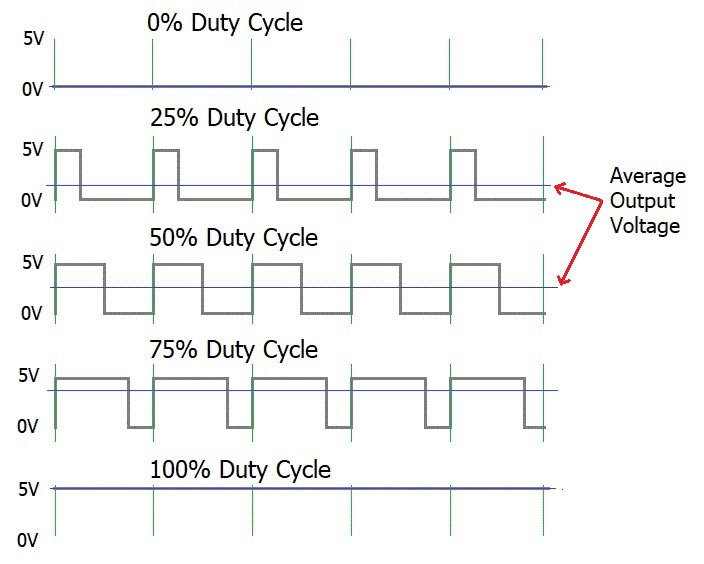
Pulse width modulation and duty cycle example - credit circuitdigest.com
While there is an overall screen refresh frequency factor to consider as it pertains to health, in short, given a fixed frequency, to reduce the brightness, at default settings, the color cell is extremely rapidly turned on and off. A 50% duty cycle has the cell on or off half of the time, and is about half the brightness. It also effectively strobes the user at a different frequency than the display as a whole is doing.
Pulse Width Modulation has been used in OLED iPhones since the iPhone X, and it is vital to the operation of the screen. It has always been a concern at some level, to some people. However, the iPhone is a hand-held device, not occupying the a large percentage of field of vision that the Apple Vision Pro and PROLED MacBook Pro maintain.
How bad is this?
We've been watching for reports of photosensitivity since the new iPad mini and PROLED MacBook Pro launched, like we did for Apple Vision Pro. There are periodic social media reports of headaches and fatigue.
The advice is clear from the doctors we've spoken to, and from Apple itself. If you start feeling strange in any way while using Apple Vision Pro, and now MacBook Pro, stop using it, and schedule an appoint with your doctor.
And, watch for symptoms in folks that you care about that are new owners. It's easy to get over-excited about new technology, and use it for far more than you should in the early days.
Apple has help for this on the iPhone, but not yet the MacBook Pro.
No good way to reduce strobing from the MacBook Pro
There's a setting on iPad mini, and iPhones after the iPhone 17, called Display Pulse Smoothing. It lives in Accessibility, and when the feature is on, it disables pulse width modulation and uses voltage dimming to provide a different way to dim the OLED display.
This is not in macOS. At least, not yet.
As of November 10, 2026, if you know you're sensitive to Pulse Width Modulation or strobing, do not buy the new MacBook Pro with PROLED display. Stick with the previous models.
Source: Read original article


Comments ()